General Relativity Corrections
General Relativity corrections can be enabled with the Use GR parameter in the param.dat file.
Three different methods of GR corrections are available:
Hamiltonian Splitting
Implicit midpoint
Direct force
Hamiltonian splitting (UseGR = 1)
The Hamiltonian splitting method is implemented according to [SahaTremaine94]. The GR (or also called post Newtonian) Hamiltonian takes the form:
with
and the speed of light c.
Following [SahaTremaine94], the \(\gamma\) term is expressed as
with the time step \(dt\). This term is combined with the Sun-kick term.
The \(\beta\) term can be expressed as
and is combined with the Kick operation, but not affected by the changeover function.
The \(\alpha\) term is implemented through a time step modification in the particle drift operation (and also the close encounter direct integrator):
To apply the described GR Hamiltonian splitting, the velocities must be converted into pseudovelocities. Since GENGA allows the use of other non-Newtonian forces, which also can depend on the velocities, we need to compute those terms in real velocities and not pseudovelocities. Therefore we convert at each time step from real velocities to pseudovelocites and back. Only the Sun-kick and the drift operation is done in pseudovelocities.
Implicit Midpoint (UseGR = 2)
The acceleration of the GR (post-Newtonian) effect can be approximated following [Kidder95] [MardlingLin02] or [Fabrycky10] as:
where \(c\) is the speed of light and \(\eta\) is defined as:
Since the equation (6) depends on the positions and the velocities, the GR corrections must by applied with the implicit midpoint method. In that way the symplectic nature of the integration is conserved.
Direct Force (UseGR = 3)
It is also possible to apply the equation (6) without the implicit midpoint method. But then the integration is not fully symplectic and the semi-major of the affected bodies is not constant. Therefore this mode is mainly for testing and for comparisons.
Test and comparison
A good object to test the general relativity effect is the asteroid (1566) Icarus. It has an orbital eccentricity of 0.83 which leads to a closed approach to the Sun of about 0.2 AU. In order to test the orbit or Icarus, we integrate it together with the 16 most massive objects of the Solar System. All data are taken from the JPL HORIZON system. We compare our integration with the measured orbit of Icarus. The results are shown in Fig. 10. One can clearly see how the GR corrections improve the orbital positions during the first few orbital periods. Comparing the Hamiltonian splitting approach with the implicit midpoint method leads to no significant difference. The integration precision can be improved, when the 16 perturber objects are not integrated, but rather interpolated from the known ephemeris. The remaining difference in the orbital position after applying the GR corrections is most likely caused by other non-gravitational effects. Or also small deviations in the initial conditions get increased at each orbit.
Since the GR effect calculation scales only linearly with the number of particles N, the performance of large simulations (\(N \gtrapprox 4096\)) is only affected marginally. Simulations with \(N \approx 1024\) are affected by ca. \(1\%\), while small simulations are affected more. A simulation with 16 fully interacting bodies can take up to 1.5 times as long with implicit midpoint method, and more than twice as long with the Hamiltonian splitting method. We recommend using the implicit midpoint method, since it gives a better performance. In Figure Fig. 11 is shown a comparison of the performance between the GR modes.
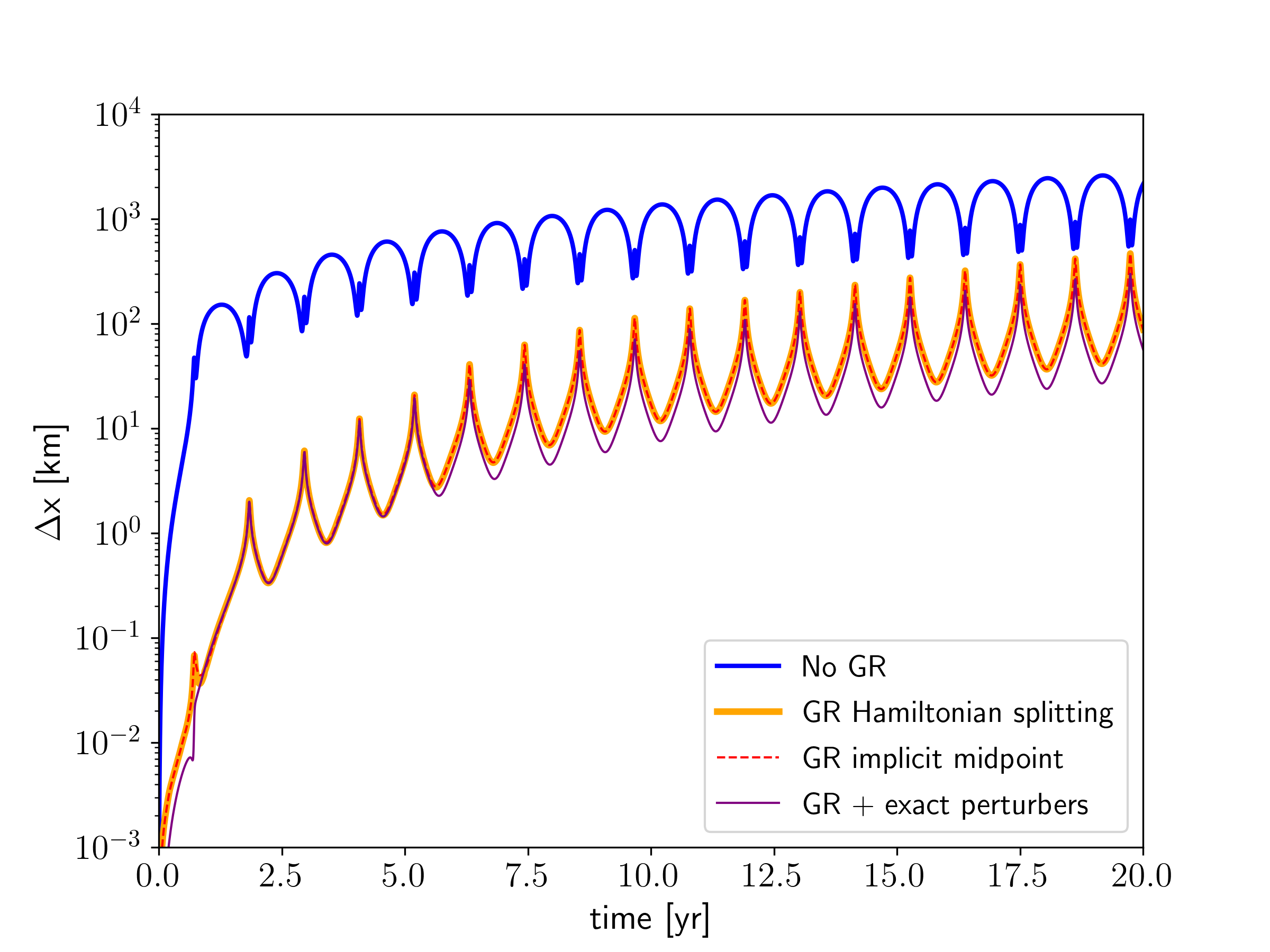
Fig. 10 Difference in position of the asteroid (1566) Icarus between the integration and the measured orbit. The Asteroid Icarus is integrated together with the 16 most massive objects of the Solar System. When GR corrections are not considered (blue line) then the position after two orbital periods differs by more than 100 km. With GR effects enabled, the difference is less than two km. There is not significant difference between the Hamiltonian splitting approach (orange line) and the implicit midpoint method (red dashed line). When the position of the 16 perturbers is not integrated, but interpolated from their measured positions, then the difference in position is reduced further (purple line).

Fig. 11 Performance of the GR modes on two GPUs for a set of N fully interactive particles.